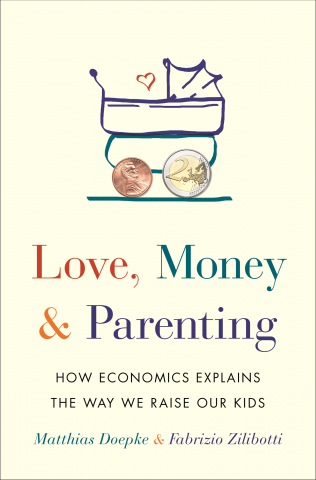
An international and historical look at how parenting choices change in the face of economic inequality
Parents everywhere want their children to be happy and do well. Yet, how parents seek to achieve this ambition varies enormously. For instance, American and Chinese parents are increasingly authoritative and authoritarian whereas Scandinavian parents tend to be more permissive. Why?
Love, Money, and Parenting investigates how economic forces and growing inequality shape how parents raise their children. From medieval times to the present, and from the United States, the United Kingdom, Germany, Italy, Spain, and Sweden, to China and Japan, Matthias Doepke and Fabrizio Zilibotti look at how economic incentives and constraints such as money, knowledge, and time influence parenting practices and what is considered good parenting in different nations.
Through personal anecdotes and original research, Doepke and Zilibotti show that in countries with increasing economic inequality, such as the United States, parents push harder to ensure their children have a path to security and success. Economics has transformed the hands-off parenting of the 60s and 70s into a frantic, overscheduled activity. Growing inequality has also resulted in an increasing "parenting gap" between richer and poorer families, raising the disturbing prospect of diminished social mobility and less equal opportunities for children from different backgrounds.
In nations with less economic inequality such as Sweden, the stakes are less high, and social mobility is not under threat. Doepke and Zilibotti discuss how investments in early childhood development and the design of education systems factor into the parenting equation, and how economics can help shape policies that will contribute to the ideal of equal opportunity for all.
Love, Money, and Parenting presents an engrossing look at the economics of the family in the modern world.
Buy the Book
Available as hardcover, ebook, audiobook, and audio CD. Amazon preview includes substantial portions of first chapters.
Chinese edition Japanese edition Korean edition Turkish edition Hungarian edition
Endorsements
"Love, Money, and Parenting presents a fascinating, insightful analysis of the origins and consequences of different parenting styles over time and place. Doepke and Zilibotti explain how and why parents shape child preferences and skills to adapt their offspring to the anticipated social and economic realities facing them as adults. The authors creatively use basic economic theory to integrate and interpret a vast body of evidence from multiple disciplines. This ambitious, well-argued book carefully examines how families influence the social and economic fortunes of their children."
"Economics is usually the last thing on people's minds when they think about parenting. This wonderfully readable and original book aims to change that. It shows how different parenting styles are all about trade-offs, how they shape the way children explore and experiment with the world and take risks, and how economic factors have played an important role in the striking changes we have experienced in the way parents think about their children and parent them. A must-read."
"In their stimulating account of the reasons behind different parenting practices, Doepke and Zilibotti unashamedly argue for an economic interpretation, while also including social and cultural factors. Worryingly, the authors show how emerging societal divisions could enable some parents to promote their children even as they disable the efforts of parents in more difficult economic circumstances. Parenting regimes by class threaten equal opportunities, social mobility, and political participation. The authors' hope is that thoughtful policy interventions can head off such threats."
"Presenting many key findings and novel explanations, Love, Money, and Parenting argues that we can use economic principles to explain why different parenting styles exist across different countries and within countries at any given point in time. At once intelligent, sophisticated, and accessible, there is no other book that tackles the same themes as this one. I really enjoyed reading it."
"Bringing together personal experiences, reasoning, and evidence, this fascinating and persuasive book shows that parenting decisions are governed by incentives and an economic approach can help us to understand why parents' choices might vary across countries and over time. The wealth of information, detail, and strength of economic argument is impressive."
Read (and Watch and Listen) about the Book
Featured
- The Parenting Trap (Susie Allen, University of Chicago Magazine, February 2021)
- The 10 Best Parenting Books of the Decade (Patrick Coleman, Fatherly, 12/23/2019)
- Honey, Income Inequality Led Me to Overwork the Kids (Innovation Hub by WGBH/Public Radio International, 6/7/2019)
- How Can Economics Help Us Explain Parenting (Interview with Matthias Doepke, Latest Thinking, 3/27/2019)
- Warum "Helikopter-Eltern" vieles richtig machen (als PDF) (Anke Schipp, Frankfurter Allgemeine, 3/3/2019)
- The parent trap (Washington Post, 2/22/2019)
- The real reason behind the rise of helicopter parenting (Jenny Anderson, Quartz, 2/14/2019)
- The Bad News About Helicopter Parenting: It Works (Pamela Druckerman, New York Times, 2/7/2019)
- Why Swedes Are Chiller Parents Than Americans (Interview with Fabrizio by Joe Pinsker, The Atlantic, 2/6/2019)
More Coverage
Coverage since June 2019: De Correspondent, Active Beauty, Baby Gaga, The News Lens, JRJ, CJ, PTT News, Weinberg Magazine, Fritz und Fraenzi, LA Review of Books, NPR Steve Pomeranz Show, NPR Steve Pomeranz Show, The Guardian, Berner Zeitung, Harpers, WSI Magazine, The Fire, La Nacion, Jing Daily, WNYC, Deutschlandfunk, Deutschlandfunk, Inside Higher Education, Northwestern Magazine, Wall Street Journal, Weixin, Financial Times, Agenda Magasin, Choice Reviews, PBS News Hour, BBC, Cowles Foundation, Svenska Dagbladet, More than a few words blog, Deutschlandfunk, BBC Mundo, BBC, New York Times, Daily Mail, China Daily, Japan Spotlight.
- Exploring the Causes and Consequences of Parenting Methods in Modern Society (China Social Sciences Network, 6/24/2019)
- Ich glückliches Helikopterkind (Caroline Rosales, Die Zeit, 6/21/2019)
- Gør I bare nar af curlingmor, men hun griner sidst og bedst for hendes børn sejrer (Berlingske, 6/21/2019)
- Interview with Yale economist Zilibotti: The economy determines how we raise children (The Paper (China), 6/19/2019)
- Plus le chômage augmente, plus les parents poussent leurs enfants à l'école ! (Marc Belpois, Telerama, 6/19/2019)
- Bilingual kids: Foreign languages are an emerging trend in day care (Andrea Guthmann, Chicago Tribune, 6/18/2019)
- Overprotective parents have more successful kids, study finds (Jennifer Hartnett, healthymummy.com, 6/17/2019)
- Qué nos enseña la economía sobre el cuidado de nuestros hijos (Sebastián Campanario, La Nacion, 5/26/2019)
- Matthias Doepke Interview of the Money Life Show (Live the Money Life with Chuck Jaffe, 6/15/2019)
- Review of "Love, Money, and Parenting" (James Ledbetter, Yale Alumni Magazine)
- The Economics of Parenting: 2019 Woodward Lecture (Fabrizio Zilibotti, 5/6/2019)
- 'L'economia condiziona l'educazione dei figli' (Gabriele Catania, il caffe, 5/12/2019)
- Helicopter parenting gone wild! Family paid $6.5M to get daughter into Stanford (Andrew Keshner, MarketWatch, 5/2/2019)
- Se le disuguaglianze economiche cambiano il modo di crescere i figli (Fabrizio Zilibotti, ilsole24ore.com, 4/18/2019)
- Dumb Questions for Smart People: Why Helicopter Parenting Is a Response to Income Inequality (Wil Hylton, Wealthsimple Magazine, 4/24/2019)
- Helicopter Parenting (Tea for Teaching Podcast, 4/24/2019)
- Wie der Erziehungsstil den Erfolg Ihrer Kinder beeinflusst (Charlotte Zink, Die Welt, 4/13/2019)
- The problem with helicopter parenting is that it works (Natalie Reilly, Sydney Morning Herald, 4/11/2019)
- Der Kampf gegen Elterntaxis ist auch ein Klassenkampf (Kristina Schröder, Die Welt, 4/11/2019)
- Tutors, private test prep coaches, homework therapists. Rich kids have all the academic advantages money can buy. But at what cost? (Andrea Guthmann, Chicago Tribune, 4/5/2019)
- It's harder for you than them, goodbye Ogie (Kathy Michaels, Revelstoke Review, 4/5/2019)
- Podcast with Fabrizio Zilibotti on Norwegian Radio (Verdibørsen, 4/4/2019)
- The Wisdom of Helicopter Parents (Kay Hymowitz, IFS Studies, 4/3/2019)
- Poczytaj mi, mamo, czyli odpowiedz na nierównosci spoleczne (Oliwia Komada, Gazeta Prawna, 4/1/2019)
- Love, Money, and Parenting by Matthias Doepke and Fabrizio Zilibotti (FT's Books, 3/25/2019)
- Økonomiske forskjeller gir strenge foreldre (Sigurd Bjørnestad, Aftenposten, 3/25/2019)
- Financial Differences Provide Strict Parents (Sigurd Bjørnestad, Vaaju, 3/25/2019)
- How to know whether you're a 'helicopter parent' and why it matters (Elissa Strauss, CNN, 3/22/2019)
- «Wir können durchaus konsequent sein»: Ein bekennender Helikopter-Papa wehrt sich gegen Kritik an seinem Erziehungsstil (Diana Hagmann-Bula, Tagblatt, 3/22/2019)
- A wiretap brings privilege and helicopter parenting to the fore in the college admissions scandal (Benjamin Oreskes, LA Times, 3/21/2019)
- The Dark Side of Helicopter Parenting (Andrew Keshner, MarketWatch, 3/20/2019)
- The Shift from Permissive Parenting to Helicopter Parenting (ChildUp, 3/18/2019)
- L'influsso dei "genitori elicottero" si fa sentire (Ticino News, 3/17/2019)
- Der Volle Einsatz der Eltern zahlt sich aus (Nadja Pastega, Tagesanzeiger, 3/17/2019)
- Se hai 'genitori elicottero' avrai più successo nella vita (la Regione, 3/17/2019)
- America's Middle Class Parents Are Working Harder for Less (Patrick Coleman, Fatherly, 3/15/2019)
- Love, Money, and Parenting (Interview with Fabrizio Zilibotti, VoxEU.org, 3/15/2019)
- TV segment in "aspekte" (ZDF Germany, 3/15/2019)
- How to helicopter parent the right way (Jenny Anderson, Quartz, 3/15/2019)
- The wealthy get A-star for gaming the system (Jenny Russell, The Times, 3/14/2019)
- Fyr opp helikoptrene, foreldre! (Eva Grinde, Dagens Næringsliv, 3/13/2019)
- Wie die Ökonomie die Erziehung beeinflusst (Fabrizio Zilibotti, Tagesanzeiger, 3/13/2019)
- Helikoptereltern machen Kinder unglücklich (Kerstin Kullmann, Der Spiegel, 3/9/2019)
- Waarom zijn ouders helikopters geworden? It's the economy, stupid (Dries de Smet, De Standaard, 3/9/2019)
- How economics explains the way we raise (and will raise) our kids (Finanz und Wirtschaft, 3/6/2019)
- Wirtschaft wirkt bis in die Kinderstube (Finanz und Wirtschaft, 3/6/2019)
- What Kind of Parent Are You? (Giuseppe Sorrenti, BOLD Blog, 3/6/2019)
- Matthias Doepke Interview with "This Morning" Radio Program (South Korea) (3/5/2019)
- How Economics, Child Care Policy, and Job Markets Affect Parenting Styles (Patrick Coleman, Fatherly, 3/4/2019)
- Our kids' stress may be rooted in income inequality (April Kelly-Woessner, Lancaster Online, 3/3/2019)
- Amor, dinheiro e os pirralhos correndo pela casa (Victoria Mantoan, seudinheiro, 3/2/2019)
- Americans Are Often Told to Parent Like Scandinavians. Here's Why That's Impossible (Time, 3/1/2019)
- Je rodic pedant, nebo pohodár? Podle vedcu za tím stojí ekonomika (OnaDnes, 3/1/2019)
- Siete genitori elicottero o mamme tigre? (Fabrizio Zilibotti, Corriere della Sera, 3/1/2019)
- How Parental Pressure Can Rise With Income Inequality (Robert Lavine, Psychology Today, 2/25/2019)
- How Economics Explains the Way We Raise Our Kids, with Matthias Doepke (Martin Bamford, Informed Choice Radio, 2/25/2019)
- Collapsed Korean educational ladder should be rebuilt with full public education (Jung Jae-hong, Yahoo News Japan, 2/25/2019)
- Why Pushy Parenting Works After All (Rachel Carlyle, The Times, 2/23/2019)
- Let's Give America's 'Helicopter Parents' a Break! (Sam Pizzigati, Inequality.org, 2/22/2019)
- Les livres de la dernière minute (BFM TV, 2/22/2019)
- How economic inequality gives rise to hyper-parenting (Chicago Tribune, 2/22/2019)
- L'éducation, cet inépuisable sujet d'étude (Julien Damon, Les Echos, 2/22/2019)
- Así afecta el entorno económico a la crianza de los hijos (Florencia Lopez-Boo, El País, 2/22/2019)
- Why helicopter parenting might not be so bad and why not to move to Sweden (Tracy Weiner and Anne Johnson, WGN Radio, 2/21/2019)
- The parenting problem: what value do we place on caring? (Emma Jacobs, Financial Times, 2/20/2019)
- Helicopter parenting: Does it work? And at what cost? (Amy Bell, CBC News, 2/19/2019)
- LE MAMME E I PAPÀ POSSONO CAMBIARE IL MONDO. PARLA L'ECONOMISTA ZILIBOTTI (Gabriele Catania, Stati Generali, 2/19/2019)
- Parents hélicoptères : comment l'angoisse des inégalités pousse les parents à surinvestir l'éducation de leurs enfants (Pierre Duriot, Atlantico, 2/17/2019)
- Der Druck auf die Eltern hat zugenommen, sagt der Professor für Entwicklungsökonomie (Patrick Imhasly, NZZ am Sonntag, 2/17/2019)
- Parenting in Manhattan is a Darwinian struggle (Emma Brockes, The Guardian, 2/15/2019)
- Helikoptereltern - alle lästern, aber das Konzept funktioniert (Gernot Kramper, Stern, 2/15/2019)
- Does helicopter parenting give kids smoother ride to success? (Maureen Downey, AJC, 2/15/2019)
- Helicopter Parenting Leads To Successful Kids (Jayme Kennedy, moms.com, 2/15/2019)
- Helicopter Parents: Blame the gap between the rich and the poor in society (UDN (Taiwan), 2/15/2019)
- A year after the Parkland massacre, we still aren't protecting our children (Helaine Olen, Washington Post, 2/14/2019)
- Cosa vuol dire essere genitori elicottero con figli iper protetti (ma di successo?) (Francesca Zottola, Elle, 2/14/2019)
- Economics professor finds helicopter parenting linked to countries with high economic inequality (Josiah Bonifant, Daily Northwestern, 2/14/2019)
- Éduquer, c'est compliqué (Julien Damon, Lettre du Cadre, 2/13/2019)
- Se l'economia influenza lo stile genitoriale (Monica Coviello, Vanity Fair, 2/10/2019)
- Helicopter parenting might not be so bad after all (Kyla Cathey, earth.com, 2/10/2019)
- Research Proves Helicopter Parenting Leads to Successful Kids (Audrey Goodson Kingo and Joseph Barberio, Working Mother, 2/8/2019)
- Helicopter parenting works (Tim Collins, Daily Mail, 2/8/2019)
- Northwestern author examines how economics influences parenting styles (Hilary Hurd Anyaso, Northwestern News, 2/5/2019)
- Economist Fabrizio Zilibotti on how economics shapes parenting (Mike Cummings, Yale News, 2/5/2019)
- Birth of a Queer Parent (Carolyn Dever, Public Books, 2/5/2019)
- The economic case against free-range parenting (MarketWatch, 2/5/2019)
- Ökonomen erklären, was Liebe, Geld und Kindererziehung miteinander zu tun haben (Thomas Jahn, Handelsblatt, 1/24/2019)
- Opdragelse, der betaler sig (Anders Boas, Weekendavisen, 12/28/2018)
- The parenting gap (RSA Journal, 9/10/2018)
Blog Posts
- Should We Celebrate Mother's Day Every Week? (Princeton University Press Blog)
- Why are Parents so Scared about College? The Economics Behind the College Admissions Scandal (Psychology Today)
- Introducing Love, Money, and Parenting (Psychology Today)
- Take the Quiz: What is Your Parenting Style? (Princeton University Press Blog)
- Matthias Doepke and Fabrizio Zilibotti on Love, Money, and Parenting (Princeton University Press Blog)
- The Economics of Motherhood (Princeton University Press Blog)
Events
- Wednesday, January 9, 2019: Seminary Coop Bookstore, 6 pm (5751 S Woodlawn Ave, Chicago, IL 60637).
- Friday, February 22, 2019: Stati Generali Brains Day.
- Tuesday, March 12, 2019: University of Oslo Library, 2 pm.
- Wednesday, March 27, 2019: Sterling Library at Yale University.
- Tuesday, April 30, 2019: Woodward Lecture, University of British Columbia (Woodward 5, 2194 Health Sciences Mall).
- Thursday, May 30, 2019: Pi Capital, 7:45 am (16 St James's Street, London SW1A 1ER).
- Thursday, May 30, 2019: RSA (Royal Society for the encouragement of Arts, Manufactures and Commerce).
- Wednesday, June 11, 2019: Fudan University, Shanghai.
- Thursday, June 13, 2019: Yale Center Beijing.
- Saturday, June 15, 2019: Jiantou bookstore Beijing.
- Thursday, September 12, 2019: CLSA Investors Forum Hong Kong.
- Monday, September 23, 2019: Selten Salon, Bonn.
Download Data and Codes
The links below provide replication code for each figure and table in the text, as well as for statistics that are reported in the body of the book and that are based on our own calculations. The replication files are organized by chapter. Within each chapter, each figure and table has its own self-contained folder which contains the Stata code, data file, and README documentation to recreate the relevant material. If the chapter includes additional statistics based on our own calculations, we include a folder called "Num" that contains the relevant code and documentation.